Returning to news coverage from Venezuela where Nicolas Maduro has won the presidential election against challenger Henrique Capriles in an estimated 51 to 49 percent of the vote. Maduro's supporters turned out in the streets to celebrate.
With the nation still reeling from Hugo Chavez' death, voter turnout was high at 78%, though not as high as the last election in which Chavez swept into landslide victory with 81% casting ballots in what the Carter Institute has described as the best election system in the world. The election was closer than expected, keeping many on the edge of their seats, with Maduro winning by about 300,000 votes.
Mr. Capriles has demanded a recount, his Caracas campaign manager Jorge Millan asserting, "The electoral authorities are partisan towards the government."
In response, an election official scoffed, "Henrique Capriles is the current governor of Miranda state. The system is good when you win, but not when you lose?"
President-Elect Maduro reportedly welcomed the recount to leave no doubts about his six year term. He has given an acceptance speech, and his election win is formally recognized by the major Latin American leaderships, notably beginning with Argentina, Ecuador, and congratulatory statements by Raul Castro in Cuba.
President-Elect Maduro pointed out in his acceptance speech that the right often wins elections by much narrower margins, without objection to that same process that puts their own candidates in seats, and presenting additional perspective on this latest win by the left.
"In other countries like in the United States," he said, "A president whose name I won't mention won by a margin of 0.3% and ruled for 8 years after that. And what did the opposition candidates say about that? Not a word. In Mexico, a president won by 0.3% and governed a full six-year term. What did the left say when they lost the election? That the election results must be respected. There are many cases like that. Here we won with 2% - that's 300,000 votes in the middle of an electoral war - for the first time [in a situation in which]* "the giant" (Chavez) is not a candidate."
The Maduro campaign had criticized Mr. Capriles for his ties and support by that unnamed U.S. president and friends, notably former Bush state department officials Otto Reich and Roger Noriega.
Venezuela political observer and analyst Greg Wilpert says that a recount is likely approved by the election authorities based on the 2% margin, a process fairly easily accomplished within a few days, though not automatically. Mr. Wilpert describes a system in which voters normally cast both a paper and electronic ballot, and then, about 53% of the paper ballot boxes are randomly selected for a paper ballot count. This 53% paper ballot count is what is normally compared to the electronic vote count to ensure veracity. What Mr. Capriles essentially wants is for all the ballot boxes to be opened and compared to the electronic count.
*Editor's bracketed clarification with respect to the translation.
Showing posts sorted by date for query hugo chavez. Sort by relevance Show all posts
Showing posts sorted by date for query hugo chavez. Sort by relevance Show all posts
Tuesday, April 16, 2013


Thursday, April 4, 2013
Maduro Leads
Turning again to events unfolding in Venezuela, elections are now in full swing -- interim President Nicolas Maduro, Hugo Chavez' former vice president and chosen successor, well in the lead, with the April 14th vote predicted as a landslide. From IPS,
More below in video coverage from Venezuela:
*Photo credit/courtesy of LA Times/Photographer: Juan Barreto/April 4, 2013, Venezuelan interim President Nicolas Maduro and his wife Cilia Flores greet supporters during a San Carlos campaign rally.
Real News reports President Maduro's campaign themes include a deepening of Hugo Chavez' legacy, reduction of the homicide rate, and that the opposition is receiving support from the United States - primarily through former Bush state department officials, Otto Reich and Roger Noriega.Maduro, the new leader of the United Socialist Party of Venezuela (PSUV), and Henrique Capriles, the candidate of the heterogeneous opposition coalition, will face off at the polls to win the six-year term to which the late Hugo Chávez (1954-2013) had been re-elected in October.
More below in video coverage from Venezuela:
*Photo credit/courtesy of LA Times/Photographer: Juan Barreto/April 4, 2013, Venezuelan interim President Nicolas Maduro and his wife Cilia Flores greet supporters during a San Carlos campaign rally.
Wednesday, March 13, 2013
Social Safety Net
An opinion piece from Thom Hartmann on Hugo Chavez and the primary importance of a sturdy social safety net.
Friday, March 8, 2013
Legacy
Over two million people turned out in the streets of Caracas Friday for the funeral of the late President Hugo Chavez.
The funeral was attended by dignitaries throughout Latin America, including Bolivia's President Evo Morales. Like Venezuela, Bolivia has declared a 7 day period of mourning for the late President who died Tuesday after a two year fight against cancer.
More here and here and here on the life and legacy of Venezuela's Hugo Chavez.
Saturday Update:
Below, excerpts from the ceremonies, including a speech made by Nicolas Madura. The vice president was sworn into office friday, with another election slated in a month. Prior to his death, President Chavez announced the vice president as his preferred successor.
President Madura stated, "All of our commander’s life has been a testament. His words, his passions, his work, his people, the people of Venezuela, is his testament." He continued, saying that Chavez left behind a system of primarily five principles and values:
The ceremony was punctuated by the many world dignitaries and groups lining up around the late president's casket for a moment of silence.
From the United States, Reverend Jesse Jackson attended ceremonies and said a prayer:
The funeral was attended by dignitaries throughout Latin America, including Bolivia's President Evo Morales. Like Venezuela, Bolivia has declared a 7 day period of mourning for the late President who died Tuesday after a two year fight against cancer.
More here and here and here on the life and legacy of Venezuela's Hugo Chavez.
Saturday Update:
Below, excerpts from the ceremonies, including a speech made by Nicolas Madura. The vice president was sworn into office friday, with another election slated in a month. Prior to his death, President Chavez announced the vice president as his preferred successor.
President Madura stated, "All of our commander’s life has been a testament. His words, his passions, his work, his people, the people of Venezuela, is his testament." He continued, saying that Chavez left behind a system of primarily five principles and values:
The first is to maintain the independence and achievements of this popular Bolivarian revolution. The second objective is to construct our own socialism; diverse, democratic, and Latin American rooted. The third, to project Venezuela as part of a more powerful Latin America, that will be constructed in the next few years. We see that represented here in the diversity of presidents who attended this ceremony. Number four is to construct a world of balance, of Bolivarian balance without empires. The fifth objective is a historic one: to contribute to the preservation of the planet and the survival of the human race.
The ceremony was punctuated by the many world dignitaries and groups lining up around the late president's casket for a moment of silence.
From the United States, Reverend Jesse Jackson attended ceremonies and said a prayer:
Today we are here not because Hugo Chavez died, but because he lived. We pray God that today that you will heal the breach between the U.S. and Venezuela.Actor Sean Penn was also seen in attendance; he joins a number of American activists and film figures such as Michael Moore, Danny Glover, and director Oliver Stone in hailing Hugo Chavez, in the words of Mr. Glover, "as a social champion of democracy, material development, and spiritual well-being."
Wednesday, March 6, 2013
Mourning
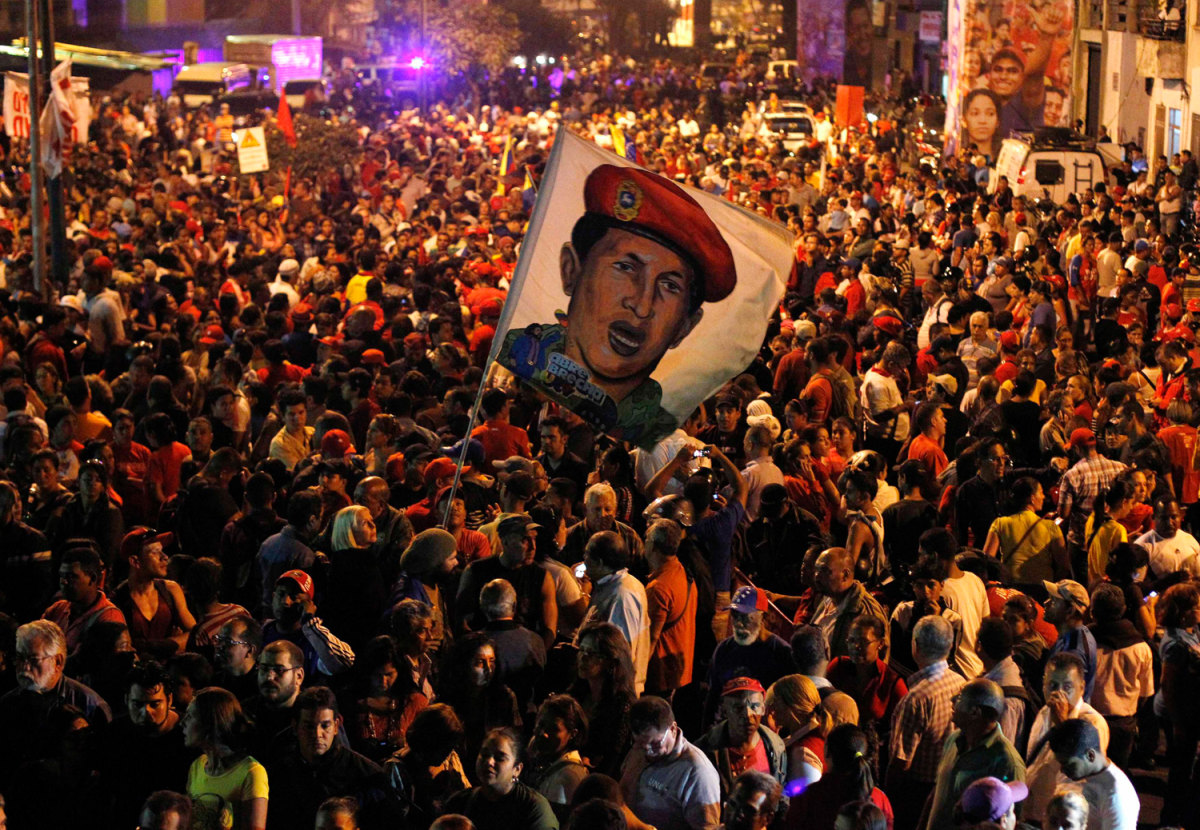
Hundreds of thousands of people are reported in the streets of Caracas today (aerial footage here), and many across Latin America, mourning the death of President Hugo Chavez on Tuesday at age 58. President Chavez had been fighting cancer.
Statements were released by world leaders, some of whom - for example, Bolivian President Evo Morales - appeared in the street procession today with Vice President Nicolas Maduro, accompanying the casket.
NBC carries a photostream here showing many Venezuelans weeping.
NBC carries a photostream here showing many Venezuelans weeping.
The vice president stated on Tuesday that Venezuelan authorities believe the late president was poisoned (i.e. cancer induced) by U.S. government operatives. At the same time, two U.S. Embassy military attachés were expelled for allegedly attempting to destabilize the country by culling right-wing military support in a plot against the Venezuelan government.
The late president who was in office for 14 years survived a 2002 coup attempt later linked to the Bush administration.
The late president who was in office for 14 years survived a 2002 coup attempt later linked to the Bush administration.
Below, video of formal statements regarding Hugo Chavez' death.
President Chavez decisively won reelection in October under an election system the Carter Center has identified as the best in the world, with the last election deemed by observers "a model of democracy." Voter turn-out was massive.
Vilified by the American mainstream press, Chavez was a more controversial figure in the United States, though he was wildly popular in Venezuela and throughout Latin America.
Widely known for redirecting Venezuela's oil wealth to the nation's impoverished majority, Chavez instituted programs that rapidly halved the national poverty rate, and decreased the extreme poverty rate by 2/3rds. The late president implemented social missions aimed at eliminating illiteracy, and he brought high school and college educations within reach of large numbers of Venezuelans previously unserved - and without putting students under the staggering burdens of a student debtor system, as in the United States.
 Chavez expanded social security for senior citizens, many of whom had no pensions, and no access to the system previously, providing a guaranteed income to older Venezuelans equivalent to the national minimum wage.
 “This is the first time that senior citizens are receiving help, and in my case I need it, because I have always been self-employed and I don’t have a pension,” stated a Mr. Luis Araque from Caracas, back in January, 2011, and when the program was first made available to women over 55 and men over 60.
The Chavez government also instituted a universal health care system, while bringing thousands of doctors into the slums of Caracas to provide free, 24 hour per day medical care. His leadership is regarded as having "spawned a massive grassroots renaissance among millions of poor Venezuelans. They now participate in community groups that do everything from running soup kitchens to installing public water systems."
More discussion of the Chavez legacy here and here on Real News and Democracy Now! and here on Truthout, and here at theguardian.
Below, from arenamierda, David Rovic's Song For Hugo Chavez.
*Photo credit/top, courtesy of NBC/photographer: Carlos Garcia Rawlins, Reuters/Supporters gather outside the hospital in Caracas/bottom, courtesy of the Embassy of the Bolivarian Republic of Venezuela/photographer: Franklin Reyes, MinCI/Learning to read and write through social missions instituted under Chavez.
Subscribe to:
Posts (Atom)